


Planning a trip to Bali? Before you pack your bags, there's one essential you can't afford to overlook — your travel adapter. Bali uses Type C and Type F (Schuko) power outlets with a 230V/50Hz supply, which means travellers from Australia, the US, the UK, and beyond all need the right adapter to keep their devices charged. But in 2026, a basic plug adapter simply isn't enough. With smartphones, laptops, cameras, and wireless earbuds all competing for power, you need a travel adapter for Bali that can actually keep up. That's where the Zyron PowerPod range comes in. Whether you're a light packer eyeing the compact 67W, a remote worker who needs the versatile 100W, or a power user demanding the full muscle of the 140W GaN charger, there's a PowerPod built for your trip. This guide breaks down exactly which model suits your travel style — and why getting this choice right makes a real difference on the road.
What Type of Plug Socket Is Used in Bali?
Before you worry about which travel adapter to pack, it helps to understand what you're actually adapting to. Bali's power infrastructure is managed by PLN (Perusahaan Listrik Negara), Indonesia's national electricity provider, and the outlet standards differ from what most Australian travellers are used to at home.
Type C and Type F — Bali's Two Plug Types Explained
There are two plug type in Bali: Type C and Type F (also known as Schuko).
Type C is a two-round-pin plug commonly found across Europe, Asia, and South America. It's ungrounded and typically used for lower-power devices like phone chargers, lamps, and small appliances.
Type F (Schuko) is also a two-round-pin plug but includes grounding clips on the side of the socket. It's the more heavy-duty of the two and handles higher-powered devices. The good news: Type C plugs fit into Type F sockets without issue, so for most travellers, Type C compatibility is all you need.
Australian plugs are Type I — a flat, angled two or three-pin design. They are not compatible with Bali's Type C or Type F sockets without an adapter. You cannot simply push an Australian plug into a Bali wall outlet.
Voltage and Frequency in Bali: Is Your Device Compatible?
Bali runs on 230V at 50Hz — the same voltage standard used in Australia (230V/50Hz). This is important because it means most Australian devices are natively compatible with Bali's voltage supply. You won't need a voltage converter on top of your adapter.
However, if you're travelling from the US or Canada, your home voltage is 110–120V. American devices that aren't dual-voltage (marked as 100–240V on the device or charger) can be damaged or destroyed by Bali's 230V supply. Always check the label on your charger brick before plugging in.
For Australian travellers, the checklist is simple:
✅ Voltage: Compatible (230V matches)
✅ Frequency: Compatible (50Hz matches)
❌ Plug shape: Not compatible — Bali adaptor required
Do Australian Plugs Work in Bali?
No. Australian Type I plugs do not physically fit Bali's Type C or Type F sockets. You will need a travel adapter to connect your Australian devices to Bali's wall outlets. There are no workarounds — this isn't a voltage issue you can ignore, it's a physical incompatibility. Pack your adapter before you leave, because quality options in Bali's tourist shops are inconsistent and often lack proper safety certifications.
Do You Actually Need a Travel Adapter for Bali?
Short answer: Yes, if you're travelling from Australia. But the longer answer is worth understanding so you know exactly what you're dealing with.
Devices That Always Need an Adapter
Any device with an Australian Type I plug needs a travel adapter in Bali. This includes:
- Smartphones and tablets — Your USB-C or Lightning cable might charge via a wall charger with an Australian plug, meaning the adapter connects the charger to the wall, not the cable to the charger.
- Laptops — MacBooks, Dell XPS, Lenovo ThinkPads, and most modern laptops use USB-C charging bricks with Australian plugs. These always need an adapter.
- Cameras and camera chargers — DSLR and mirrorless camera battery chargers almost always have fixed Australian plugs.
- Hair straighteners, hair dryers, and electric shavers — These plug directly into the wall and need an adapter. Note: high-wattage hair tools may also need a voltage check if they're not dual-voltage.
- Portable speaker chargers and travel accessories — Anything that plugs into the wall with an Australian plug.
Devices That Might Work Without One (And the Risk of Getting It Wrong)
Some devices use universal charging bricks with swappable heads, or come with a USB-A/USB-C cable that can plug into a USB charging hub. In these cases, if you're already using a multi-port travel charger like the Zyron PowerPod (which only needs one adapter connection to the wall), your individual device cables plug into the PowerPod directly — no additional adapters needed per device.
This is one of the most practical reasons to invest in a quality multi-port GaN travel charger. One adapter connection to the wall, then everything else charges via USB-C or USB-A ports. Cleaner, safer, and far less reliant on Bali's variable outlet quality.
What to Look for in the Best Travel Adapter for Bali
Not all travel adapters are equal. In fact, the difference between a $10 adapter from a Bali market and a certified GaN travel charger can be the difference between a working laptop and a fried motherboard. Here's what actually matters.
Universal Compatibility vs. Bali-Specific Adapters
A Bali-specific adapter simply converts the plug shape — Australian Type I to Type C/F. It does nothing else. No surge protection, no USB ports, no power management. It's a passive piece of plastic and metal.
A universal travel charger like the Zyron PowerPod does all of that and more. It includes the adapter functionality (Type C/F compatible plug) plus active charging management, multiple USB-C and USB-A ports, GaN technology for efficiency, and built-in surge protection. For anyone travelling with more than one device — which is virtually everyone in 2026 — a universal charger is the smarter buy.
GaN Technology: Why It Matters for Travel Chargers
GaN stands for Gallium Nitride, a semiconductor material that has replaced silicon in premium chargers. The practical benefits for travellers are significant:
- Smaller and lighter — GaN chargers deliver the same or higher wattage in a fraction of the size of traditional chargers
- Runs cooler — Less heat means safer operation in Bali's already-warm climate, and less risk of outlet damage
- More efficient — Less energy wasted as heat means faster, more consistent charging
- Multi-device capable — GaN's efficiency allows high wattage to be distributed across multiple ports simultaneously without the thermal issues that plague traditional chargers
For Bali travel specifically, the compact size of GaN chargers is a genuine advantage. Bali's resort and villa outlets are often recessed or awkwardly placed — a bulky traditional adapter can block adjacent sockets or sit at an unstable angle. A slim GaN charger sits flush and secure.
Wattage, Ports, and Charging Speed — What Actually Counts
When comparing travel adapters for Bali, these are the specs that matter:
| Spec | What It Means for Bali Travel |
| Total wattage | How much power the charger can deliver across all ports simultaneously |
| Per-port wattage | The max speed for your fastest-charging device (laptop needs at least 45W) |
| Number of ports | How many devices you can charge at once |
| USB-C PD support | Required for fast-charging modern laptops, iPads, and flagship phones |
| USB-A ports | Useful for older devices, Kindles, budget earbuds |
For a solo traveller with a phone, earbuds, and a smartwatch, a 67W charger covers everything. For a couple or anyone carrying a laptop, 100W or 140W ensures no port is ever throttled.
Safety Certifications to Check Before You Buy (RCM, CE, GaN)
This is the section most travel adapter guides skip — and it's arguably the most important. Bali's power grid, particularly outside of major resort areas, can experience voltage fluctuations. A charger without proper protection exposes your devices to real risk.
When buying a travel adapter for Bali, look for:
- RCM Mark — Australia's mandatory safety mark. Any charger sold legally in Australia should carry this. It confirms the product has been tested to Australian/New Zealand electrical safety standards.
- CE Mark — European conformity mark, relevant because Bali's outlets follow European Type C/F standards.
- Over-voltage and short-circuit protection — Listed explicitly in the product specs, not implied.
- GaN certification — Chargers from established GaN manufacturers (not unbranded white-label imports) follow stricter component standards.
Zyron PowerPod chargers are RCM certified and built to Australian safety standards — which matters when you're connecting to an unfamiliar power grid on the other side of the world.
Zyron PowerPod Travel Chargers — Built for Bali
The Zyron PowerPod range was designed with exactly this use case in mind: Australian travellers who need reliable, compact, high-performance charging in international destinations. All three models use GaN technology, carry RCM certification, and support Type C/F outlets — making them natively suited for Bali without any additional adapters or converters.
Zyron PowerPod 67W — Best for Light Travellers and Weekend Trips
The PowerPod 67W is the go-to for travellers who pack light and move fast. It's compact enough to drop into a daypack or personal item bag without a second thought, and 67W is more than sufficient for the majority of solo travellers.
Who it's for:
- Solo travellers on short Bali trips (3–7 days)
- Travellers carrying a phone, earbuds, and smartwatch
- Backpackers and minimalist packers who want one less heavy item
- Anyone whose laptop charges at 65W or below (MacBook Air M-series, smaller Ultrabooks)
Key specs:
- Total output: 67W
- Ports: 2x USB-C (PD), 1x USB-A
- GaN technology: Yes
- Plug compatibility: Type C/F (Bali compatible)
- RCM certified: Yes
Real-world Bali scenario: You're staying in Seminyak, heading out each morning for breakfast and the beach. Overnight, you plug the PowerPod 67W into your villa's Type F socket. By morning, your iPhone, AirPods, and Apple Watch are all fully charged from a single wall outlet. No adapter juggling, no multiple plugs.
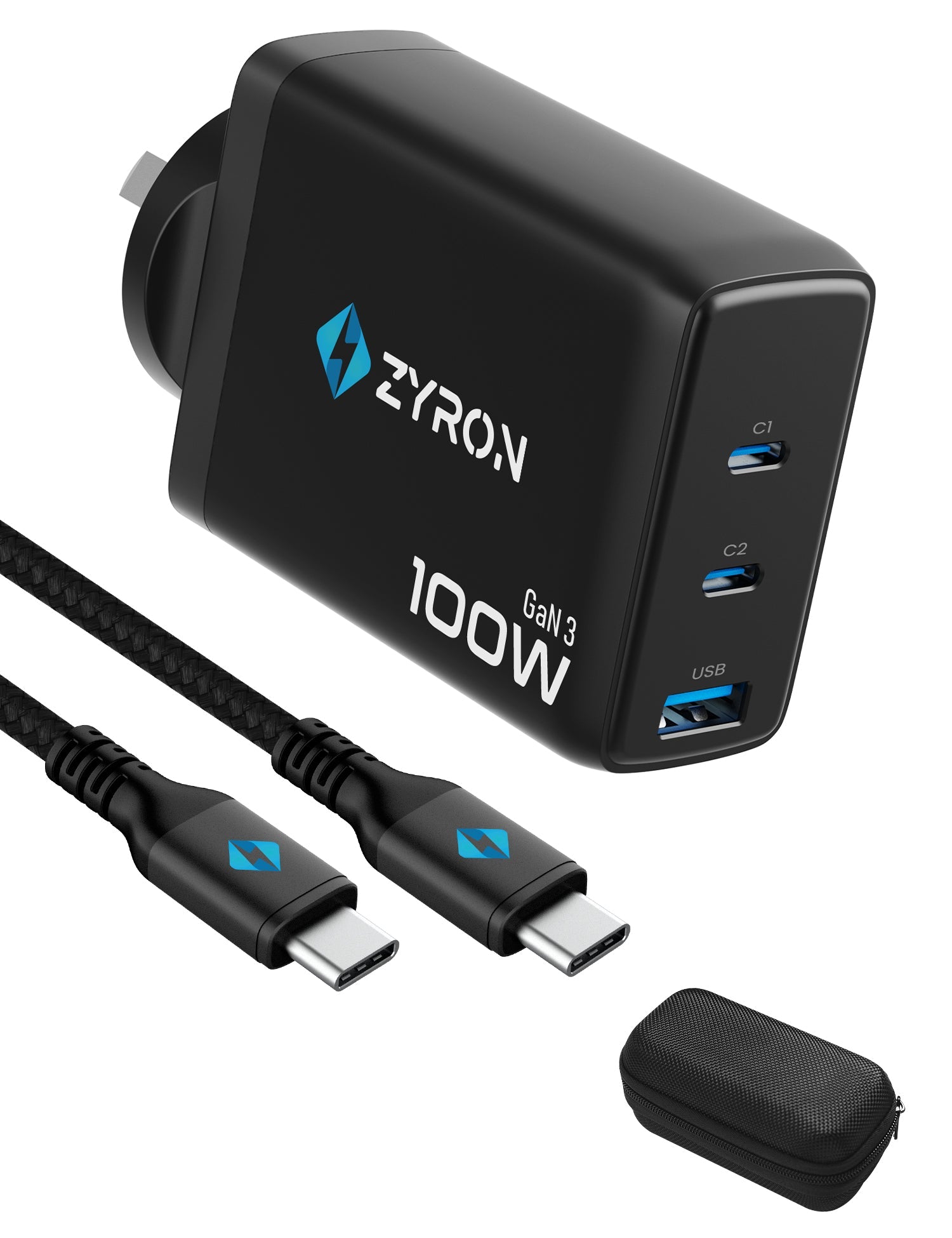
Zyron PowerPod 100W — Best for Remote Workers and Digital Nomads
Bali has become one of the world's most popular destinations for remote workers and digital nomads, and the PowerPod 100W was built for exactly this crowd. With 100W of total output and enough per-port wattage to fast-charge a 14-inch laptop, it handles a full workday setup without compromise.
Who it's for:
- Digital nomads working from Canggu or Ubud co-working spaces
- Travellers carrying a laptop plus two or more devices
- Couples sharing a single charger
- Anyone who needs their laptop charged quickly between meetings or co-working sessions
Key specs:
- Total output: 100W
- Ports: 4x USB-C (PD)
- GaN technology: Yes
- Plug compatibility: Type C/F (Travel plugs for Bali)
- RCM certified: Yes
Real-world Bali scenario: You're working remotely from a villa in Canggu. Morning: MacBook Pro charging at full speed via USB-C PD while your phone tops up on the second USB-C port. Afternoon: camera battery charger and travel speaker on the USB-A ports. One PowerPod 100W handles the entire day's power needs from a single Bali wall outlet.
Zyron PowerPod 140W — Best for Power Users and Multi-Device Travel
The PowerPod 140W is the most powerful travel charger in the Zyron range and one of the highest-output GaN travel chargers available in Australia. At 140W total, it can simultaneously charge a high-performance laptop at full speed while keeping three additional devices topped up — without any port throttling.
Who it's for:
- Travellers with high-wattage laptops (MacBook Pro 16", Dell XPS 15, gaming laptops)
- Content creators carrying cameras, drones, and audio equipment
- Families or groups sharing one charger
- Power users who refuse to compromise on charging speed, even when travelling
Key specs:
- Total output: 140W
- Ports: 3x USB-C (PD), 1x USB-A
- GaN technology: Yes
- Plug compatibility: Type C/F (Bali compatible)
- RCM certified: Yes
Real-world Bali scenario: You're a travel photographer based in Ubud for two weeks. Each evening: MacBook Pro 16" charging at 100W on Port 1, Sony camera battery charger on Port 2, DJI drone battery via USB-C on Port 3, phone on USB-A. Everything charged overnight from a single Bali wall outlet. The PowerPod 140W makes it possible.
PowerPod vs. Basic Bali Adaptor — Is There a Real Difference?
Yes — and it's not a minor one. Here's an honest breakdown of what you're actually comparing.
Why a Cheap Bali Adapter Can Damage Your Devices
A basic Bali wall adapter from a Bali market or airport kiosk typically costs under $5–10 USD.
What you get for that price is:
- A passive plastic housing with metal pins
- No surge protection
- No voltage regulation
- No power management
- No safety certifications
- Often no grounding, even for Type F sockets
Bali's power grid — particularly in villas, smaller guesthouses, and areas outside Kuta and Seminyak — can experience voltage spikes and fluctuations. Plugging an unprotected MacBook or flagship smartphone charger into an unprotected adapter during a voltage spike is a genuine risk. In the best case, your charger's internal fuse blows. In a worse case, the device itself is damaged.
A quality GaN travel charger includes active protection circuits that absorb or shut down during voltage irregularities. It's not a theoretical benefit — it's the reason certified chargers exist.
How GaN Chargers Outperform Traditional Travel Adapters in Bali
| Feature | Basic Bali Adaptor | Zyron PowerPod (GaN) |
| Plug conversion | ✅ | ✅ |
| USB charging ports | ❌ | ✅ (up to 4 ports) |
| Fast charging (PD) | ❌ | ✅ |
| Surge protection | ❌ | ✅ |
| RCM certified | ❌ | ✅ |
| Laptop charging | ❌ | ✅ |
| Size | Bulky | Compact |
| Devices per outlet | 1 | Upto 4 |
The cost difference between a $10 market Bali power adaptor and a Zyron PowerPod is real — but when you consider that a replacement MacBook charger alone costs $100+, and that a damaged device can ruin a Bali trip, the value calculation shifts quickly.
Where to Buy a Travel Adapter for Bali in Australia
Buying Before You Fly vs. Buying in Bali — What's Smarter?
Buy before you fly. Here's why:
In Bali, travel adapters are available in tourist areas, supermarkets (Pepito, Bintang, Circle K), and hardware stores. The selection is limited to basic plug adapters — you won't find a certified GaN charger in a Bali market. Prices for quality products are comparable to or higher than Australian retail once you account for currency conversion. Uncertified products from markets carry the safety risks outlined above.
In Australia, you have access to the full range of certified, RCM-compliant travel chargers. You can research, compare, and buy with confidence before you travel — and arrive in Bali ready to charge from day one.
The only scenario where buying in Bali makes sense is if you forgot your adapter entirely and need a stopgap. In that case, buy from a reputable supermarket or electronics store (not a beach market), and replace it with a certified charger when you return home.
Where to Buy Zyron PowerPod in Australia
The full Zyron PowerPod range — 67W, 100W, and 140W — is available directly through zyrontech.com.au with fast shipping across Australia. Orders placed before your departure date arrive ready to pack.
For last-minute purchases, Zyron products are also available on Amazon AU, with Prime delivery available in most metro areas.
Frequently Asked Questions — Travel Adapter for Bali
What plug adapter do I need for Bali?
For Australian travellers, you need a Type I to Type C or Type F adapter. Bali uses Type C and Type F (Schuko) round-pin sockets, while Australia uses Type I flat-pin sockets. The two are not physically compatible without an adapter. A GaN travel charger like the Zyron PowerPod includes Type C/F plug compatibility and multi-port USB charging in a single device, eliminating the need for multiple separate adapters.
Can I use my Australian charger in Bali without an adapter?
No. Australian plugs (Type I) do not fit plug socket in Bali (Type C/F). However, because both Australia and Bali operate on 230V/50Hz, you do not need a voltage converter — only a plug adapter. Once adapted, your Australian charger will work normally with Bali's power supply.
What voltage does Bali use?
Bali uses 230 volts at 50Hz — the same as Australia. This means Australian devices are voltage-compatible with Bali's power supply and do not require a separate voltage converter. You only need a plug adapter to convert the physical plug shape. If you're travelling from the US or Canada (where voltage is 110–120V), check that your devices are dual-voltage (marked 100–240V) before plugging in.
Is it safe to buy a travel adapter when I arrive in Bali?
It's not recommended as your primary plan. Adapters available in Bali's markets and tourist shops are typically uncertified, lack surge protection, and vary widely in build quality. Bali's power grid can experience voltage fluctuations, particularly in villas and smaller guesthouses, which makes surge protection genuinely important. Buying a certified, RCM-compliant travel charger in Australia before you travel is the safer and more reliable option.
Does the Zyron PowerPod work in Bali?
Yes. All Zyron PowerPod models (67W, 100W, and 140W) are compatible with Bali's Type C and Type F power outlets and operate on 100–240V, making them fully compatible with Bali's 230V/50Hz power supply. No additional voltage converter is required. Simply connect the PowerPod to Bali's wall socket and charge your devices via the USB-C and USB-A ports.
What is the best travel adapter for Bali from Australia?
For Australian travellers, the best travel adapter for Bali is one that combines Type C/F plug compatibility with GaN multi-port charging, USB-C Power Delivery, and RCM safety certification. The Zyron PowerPod range meets all of these criteria. For solo or light travellers, the PowerPod 67W is the ideal choice. For remote workers and those carrying laptops, the PowerPod 100W offers the best balance of power and portability. For power users, content creators, or groups, the PowerPod 140W delivers maximum output without compromise.




Leave a comment
All comments are moderated before being published.
This site is protected by hCaptcha and the hCaptcha Privacy Policy and Terms of Service apply.