


Every Australian traveller has had the same moment. You land in Rome, Tokyo or Los Angeles after twenty hours in the air, pull a laptop out of your bag, and realise the flat Type I plug that works in every wall socket at home fits nowhere on the planet except New Zealand, Fiji and Argentina.
That is the problem a travel adapter solves. But in 2026 the answer is no longer a bag of cheap plastic plug converters rattling around your carry-on. The better answer is a single GaN travel charger with interchangeable plug heads — one device that replaces your adapter, your laptop brick and your phone charger in one go.
This guide covers what the best travel adapter Australia has to offer actually looks like now, how plug types and voltage work across the countries Australians travel to most, and which three chargers we recommend for 2026.
Travel adapter, travel charger or voltage converter?
These three things get confused constantly, and buying the wrong one is how people fry a hair straightener in a Paris hotel room.
A travel adapter is a passive plug shell. It changes the physical shape of the pins so your plug fits a foreign socket. It does nothing to the electricity itself. A $10 adapter carrying 230V is still carrying 230V.
A travel charger is an actual power supply with USB-C and USB-A ports built in. Modern ones accept 100–240V input, which means the charger itself handles the voltage difference between countries. The best travel charger Australia buyers can get in 2026 also ships with swappable AU, US, EU and UK plug heads, so the adapter function is built in rather than bolted on.
A voltage converter is a heavier transformer that steps 230V down to 110V (or up). You only need one for high-wattage heating appliances — hair dryers, straighteners, curling wands, travel kettles — that are rated for a single voltage. You do not need one for anything that charges over USB-C.
For most trips, a good travel GaN charger removes the need for the other two entirely.
What Australian travellers need to know about plugs and voltage
Australia runs on 230V at 50Hz using the Type I plug — the two angled pins with an optional vertical earth pin. Here is how that compares to the destinations Australians fly to most:
| Destination | Plug type | Voltage | Adapter needed |
|---|---|---|---|
| New Zealand, Fiji | Type I | 230V | No |
| United Kingdom, Ireland, Singapore, Hong Kong, Malaysia | Type G | 230V | Yes |
| France, Germany, Italy, Spain, Indonesia (Bali), Thailand | Type C/E/F | 220–230V | Yes |
| United States, Canada, Mexico | Type A/B | 120V | Yes |
| Japan | Type A/B | 100V | Yes |
| Vietnam, Philippines | Type A/C mix | 220V | Yes |
| India, UAE | Type D/G | 230V | Yes |
The critical column for most people is voltage, not plug shape. Check the fine print on your device's power brick. If it reads INPUT: 100–240V ~ 50/60Hz, the device is dual voltage and only needs a plug adapter. Every USB-C charger, laptop brick, phone and camera charger sold in Australia falls into this category. Single-voltage devices — almost always something that generates heat — are the exception.
One practical note for Japan and the US: at 100–120V, a charger will still deliver its rated output, but older two-pin sockets are often loose and unearthed. A heavier charger can sag out of the wall. Packing a short extension lead solves this, and it is why we rate chargers that include a figure-8 or desktop power cable more highly for travel.
The best travel adapter plug options in Australia for 2026
We have ranked these for Australian travellers specifically — 240V home charging, long-haul flights, and multi-country itineraries where you need one kit to cover everything.
1. Zyron PowerPod 140W GaN Travel Charger — best overall
Best for: MacBook Pro owners, long-haul travellers, anyone carrying a laptop plus two or three devices.
The PowerPod 140W charger is the most capable charger we build, and for 2026 it is our pick for the best GaN charger for travel full stop. It runs Navitas GaN 5 silicon and supports USB Power Delivery 3.1, the standard that allows a single USB-C port to push a full 140W. That is enough to fast-charge a 16-inch MacBook Pro at its native speed rather than trickling it overnight.
Four ports — three USB-C plus one USB-A — mean a laptop, tablet, phone and pair of earbuds all run off one wall socket. On a plane seat, in a hotel room with one accessible outlet, or in an airport lounge, that matters more than raw wattage.
For travel specifically, the kit is the selling point. It ships with interchangeable AU, US, EU and UK plug heads, a 2m 240W USB-C to USB-C cable, a figure-8 desktop power cable and a hard zipper travel case. There is no separate travel adapter to buy, lose or leave in a drawer.
Trade-off: it is the heaviest of the three. It is a precision-built device with dense internals, and it needs to be handled with reasonable care — it is not a charger to throw loose into a check-in bag. If you are travelling with a phone and nothing else, this is more charger than you need.
Shop the PowerPod 140W GaN Travel Charger →
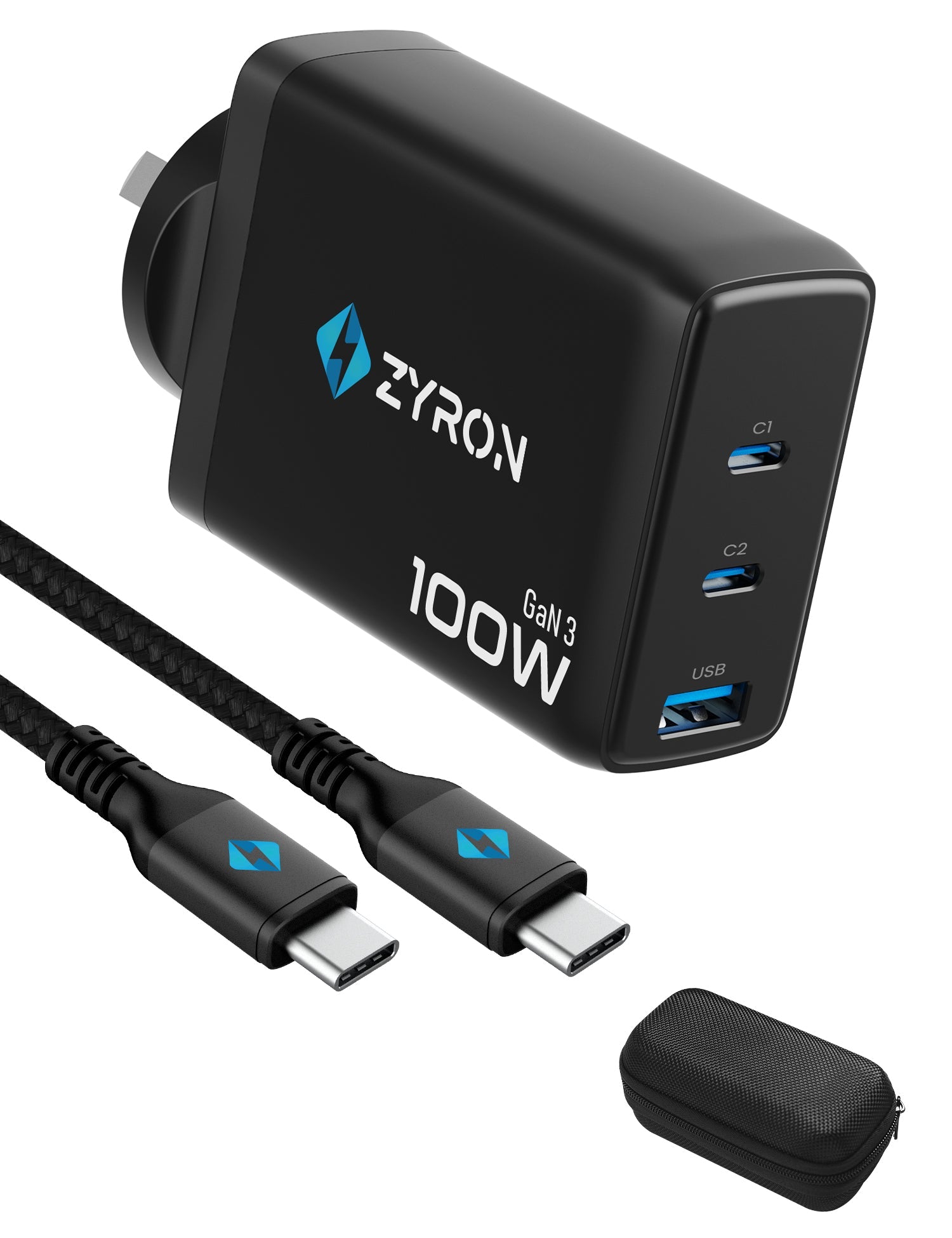
2. Zyron PowerPod 100W GaN Travel Charger — best all-rounder
Best for: most travellers, most trips.
If the 140W is the flagship, the 100W is the one we would actually pack for a two-week holiday. Four USB-C PD ports handle a laptop, tablet and two phones simultaneously with smart power management dividing output based on what is plugged in.
Its travel design is genuinely clever. The US/JP plug is fixed to the body and folds in and out, while AU, EU and UK heads clip on as needed — so for American and Japanese trips there is nothing extra to carry at all. The box includes an extension power cable, a 2m 100W USB-C cable and a hard Oxford-finish travel case, and coverage spans over 150 countries.
At 100W you can still charge a 14-inch MacBook Pro or a Dell XPS at close to full speed, and it is noticeably lighter and easier to live with than the 140W. It is backed by a 2-year Australian warranty with local support.
Trade-off: no USB-A port. If you still carry older accessories with USB-A cables, you will need a USB-C to USB-A adapter or an updated cable.
Shop the PowerPod 100W GaN Travel Charger →
3. Zyron PowerPod 67W GaN Travel Charger — best compact pick
Best for: carry-on-only travellers, phone-and-tablet trips, thin-and-light laptops.
At 55 × 55 × 31mm and 118g, the 67W is the one that disappears into a jacket pocket. It runs GaN III technology with three ports — two USB-C rated to 67W and one 18W USB-A — and supports PD 3.0, PPS, QC 4+, SFC 2.0 and AFC, so Android fast-charging is properly covered alongside Apple devices.
Two details make it the standout travel option in the range. The first is the LED charging indicator, the only one across our chargers, which tells you a device is drawing power without waking the screen — quietly useful at 3am in a hotel room. The second is that 67W sits just above the 65W class, which means a 13-inch MacBook Air or ThinkPad X1 Carbon still charges at full speed even when the charger is running warm.
It comes with universal travel plugs, a 2m 100W USB-C cable and a zipper case.
Trade-off: run a laptop and a phone together and you are sharing 67W across ports — around 45W plus 20W. Fine for topping up, slower than a dedicated laptop charger under heavy load.
Shop the PowerPod 67W GaN Travel Charger →
How to choose the right travel charger for your trip
Count your devices, then add one. The number of ports you need is almost always higher than you think once you factor in a travel companion's phone.
Match wattage to your laptop, not your phone. A 16-inch MacBook Pro or gaming laptop wants 140W. A MacBook Air, Surface or Chromebook is comfortable at 67W. Everything in between is well served by 100W.
Prefer built-in plug heads over separate adapters. Standalone universal adapters with sliding pins are bulky, and the cheap ones have a habit of losing contact in worn sockets. GaN chargers with travel adapter heads built in are a single point of failure instead of two.
Check certification. Anything you plug into an Australian wall should be RCM certified and listed on the EESS register. This is not optional and it is the first thing to check on a marketplace listing.
Pack a short extension lead. One cheap addition that fixes loose overseas sockets, awkward outlet placement behind hotel beds, and the problem of a heavy charger hanging out of the wall.
Frequently asked questions
Do I need a voltage converter for Europe or the UK? No. Europe and the UK run 220–230V, effectively the same as Australia. You only need a plug adapter. The US and Japan run lower voltage, which is safe for dual-voltage electronics but not for single-voltage heating appliances.
Can I take a GaN charger in carry-on luggage? Yes. Chargers have no internal battery and face no airline restrictions. Power banks are the ones that must travel in carry-on, never checked baggage.
Will a 140W charger damage my phone? No. USB Power Delivery negotiates the correct voltage and current with each device. A phone requesting 25W receives 25W regardless of the charger's maximum.
What is the best travel adapter plug for a multi-country trip? A charger with interchangeable AU, US, EU and UK heads covers the overwhelming majority of destinations in a single kit — no per-country shopping required.
Whichever you choose, the principle is the same: in 2026 you should be packing one charger, not a charger plus an adapter plus a converter. Browse the full Zyron GaN charger range to compare models side by side.




Leave a comment
All comments are moderated before being published.
This site is protected by hCaptcha and the hCaptcha Privacy Policy and Terms of Service apply.